two_rq
R0-(R1,CPE1)-(R2,CPE2)
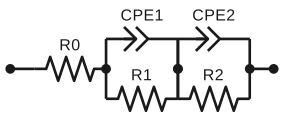
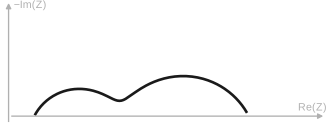
A series resistance R0 and two RQ elements, giving two flattened semicircles. The CPE version of two_rc.
ML model: 69k parameter 1D CNN, trained on synthetic data, 0.7 ms per guess. See Training.
Benchmarks
Plain LM
| source of initial parameters | converged | excess med | p90 | p99 | med sweeps |
|---|---|---|---|---|---|
| floor (truth) | 100.00% | 0 | 0 | 0 | 76 |
| library defaults | 51.20% | 368 | 717 | 1641 | 366 |
| truth x/div 5 | 55.10% | 171 | 458 | 1476 | 276 |
| ml guess | 99.60% | 15 | 62 | 246 | 91 |
Circuit.fit()
| source of initial parameters | converged | excess med | p90 | p99 | med sweeps |
|---|---|---|---|---|---|
| floor (truth) | 100.00% | 0 | 0 | 0 | 101 |
| library defaults | 77.90% | 415 | 5348 | 44383 | 685 |
| truth x/div 5 | 77.30% | 352 | 2717 | 24850 | 652 |
| ml guess | 99.70% | 15 | 62 | 294 | 131 |
Error of the guess
Relative error of each guessed parameter before fitting, in %.
R0.r |
R1.r |
CPE1.q |
CPE1.alpha |
R2.r |
CPE2.q |
CPE2.alpha |
|
|---|---|---|---|---|---|---|---|
| median | 1.2 | 5.4 | 7.6 | 1.7 | 8.6 | 36.7 | 9.6 |
| p90 | 10.5 | 24.3 | 34.6 | 7.5 | 35.5 | 113.7 | 27.6 |
| p99 | 96.6 | 94.2 | 145.8 | 16.8 | 115.9 | 380.5 | 50.0 |
Benchmark notes
Synthetic benchmarks use 1000 spectra drawn from the same distribution as the training data, with a different seed: 4 to 8 decade sweeps of 20 to 100 points, with 0.2% to 5% noise.
- floor (truth): start from the true parameters.
- library defaults: start from the
Circuit()placeholder values. - truth x/div 5: true magnitudes multiplied or divided by 5 at random, CPE exponents ±0.15.
- ml guess: start from
Circuit.guess().
Plain LM is a single-start Levenberg-Marquardt. Circuit.fit() is LM that also screens candidate starts and restarts on bad fits.
Converged: final cost within 1% of the fit from the truth. Sweeps: impedance evaluations of the whole spectrum, including Jacobians. Excess: sweeps beyond the fit from the truth, for converged fits only.